
Home / Featured Work / Under Armour
Under Armour
Frontend engineer on Under Armour's Seabiscuit e-commerce platform — shipped the Launch Calendar, led the disruptor image initiative, and improved the PDP within the past year.

Frontend engineer on the Seabiscuit e-commerce platform — Under Armour's global Next.js storefront serving millions of users across the US, Canada, and EMEA. Over ten months I shipped 50+ tickets spanning net-new features, a cross-surface SEO initiative, and PDP improvements that touched video, accessibility, and conversion.
Launch Calendar
Under Armour drops limited releases on a rolling schedule, but the site had no dedicated experience for it — product launches lived in the same grid as everything else, with no way to track what was coming, sign up for notifications, or save a launch to your calendar.
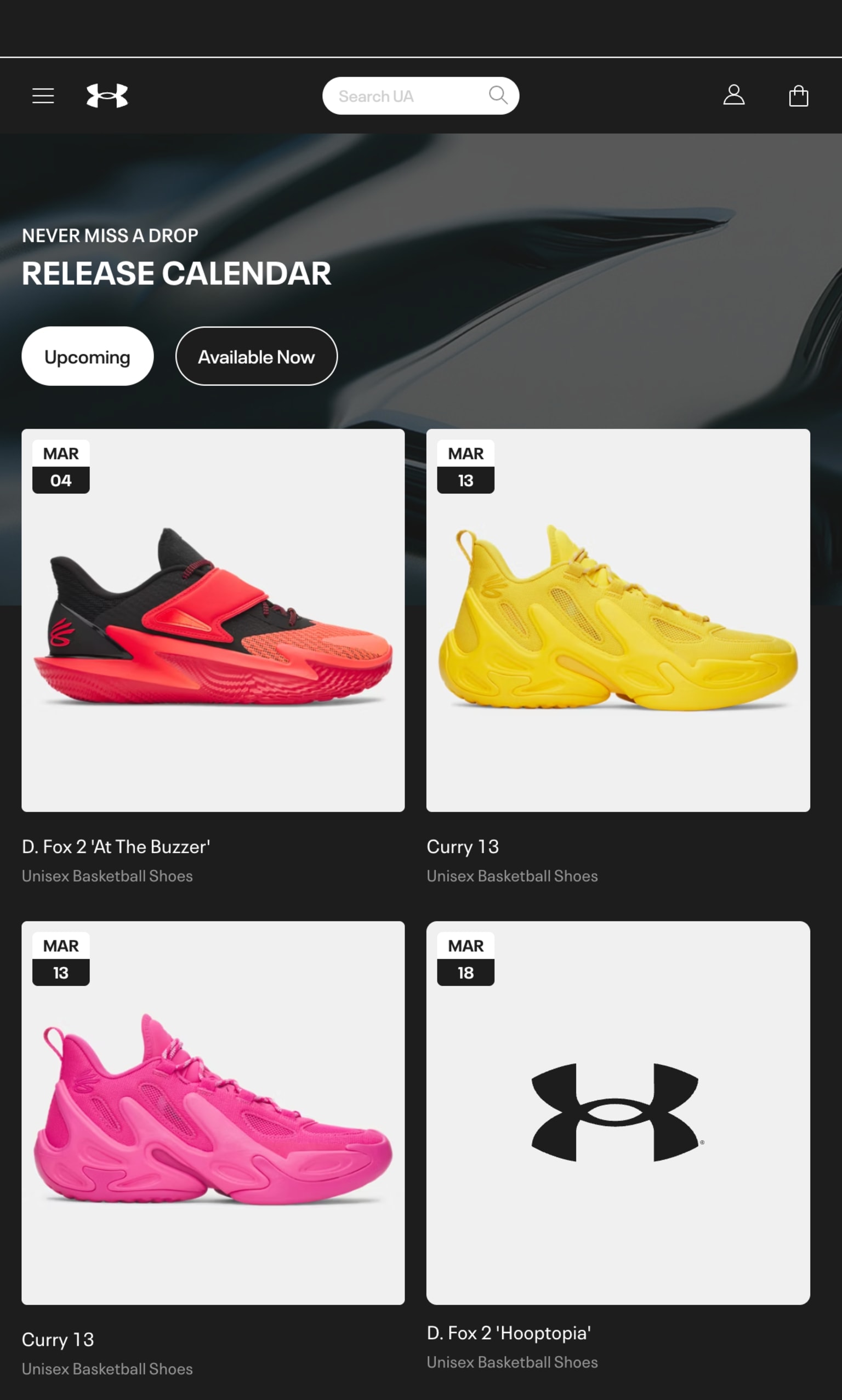

I was a core contributor on Launch Calendar 2025, a net-new product launch hub built from scratch. The feature introduced tabbed navigation separating "Upcoming" and "Available Now" releases, mobile-optimized product cards with SMS notification sign-up and calendar integration, and a "New Arrivals" recommendation zone with chronological sorting for discoverability. I also implemented FR-CA localization, extending the feature to the Canadian market on launch.
The challenge throughout was building a real-time-aware UI on top of an e-commerce platform not originally designed for time-sensitive drop culture — scheduling state, sold-out handling, and notification toggles all had to layer onto an existing component system without breaking it. SMS and calendar integration required careful coordination with backend services and feature flagging so notifications could be rolled out independently across markets.
Disruptor Image Initiative
"Disruptors" are marketing overlay images — banners, badges, promotional graphics — that appear on top of product images on the UA site. The problem: they were appearing everywhere, including places where product accuracy matters most.
I led the cross-surface initiative to bring disruptor images under control. The work spanned four surfaces: excluding disruptors from Google Organic search results (where showing a promotional overlay instead of the actual product harms SEO and click-through accuracy), removing them from the Add-to-Bag modal and cart (where customers are evaluating what they're buying), filtering them from recommendation zones (where product recognition drives engagement), and implementing a feature flag for wishlist visibility to allow configurable rollout per surface.
The SEO exclusion was the most technically interesting piece — it required understanding how the platform's image rendering pipeline fed into search crawlers and implementing the right signal to exclude disruptor-tagged assets without breaking product image indexing. The feature flag layer on top meant each surface could be toggled independently, which was critical for staged rollout and A/B validation.
Product Detail & Listing Page Updates
Stay tuned for more updates!